This is a very interesting article that recently appeared in Publishers Weekly. *******************************************************************************************
When the pandemic hit last March, manga publishers in North America were left with an uncomfortable choice: should they cut back on their book releases or stick it out and hope that things get better soon? But it turned out that while people were stuck at home, they started reading and buying more manga. And not just a little but a lot more manga.
According to NPD BookScan, the manga buying spree continues in 2021. Sales of print manga titles in the U.S. increased by 3.6 million units in the first quarter of 2021 compared to the same period in 2020.
“Last year was our biggest year ever, despite the pandemic, and 2021 numbers are off the charts,” says Lianne Sentar, sales and marketing manager at Seven Seas Entertainment. “Based on what we’re seeing in these first few months, 2021 will be the biggest year yet—we’ve truly never seen numbers like these.”
Kevin Hamric, v-p, publishing sales at Viz Media, says most publishers reported that manga sales were off to a strong start in 2020 before the pandemic hit, and by April manga sales had plummeted to “the lowest sales we’ve had in years.” But he adds that the market quickly recovered and has been on an upward trajectory ever since. “Even if 2020 had stayed on the track, 2021 is head-and-shoulders ahead. These past few weeks of 2021 are higher than holiday 2020.”
Kurt Hassler, publisher and managing director at Yen Press, a joint manga and graphic novel venture between Hachette and Japanese publisher Kadokawa, also noticed the buying trends. “For the first quarter of 2021, we saw our sales functionally double, which is well beyond anything we were forecasting,” he says.
Kodansha USA Publishing reports similar results according to Kodansha v-p of sales and marketing Yae Sahashi. “Print manga sales rocketed to a new high over holiday 2020 and, after a plateau in January, rose even higher in March and April,” she says. “In recent weeks, point of sale for the category has quadrupled year over year, even if you discount the negative impact of Covid-19 on sales last March.”
The anime effect
What’s driving all this sales growth? Some industry professionals say it’s a sign of a maturing market in which manga has established itself as part of mainstream pop culture, placing the category at the forefront of graphic novel sales, if not overall book sales in North America. Others say the growing popularity of anime on such streaming platforms as Amazon Prime, Hulu, Netflix, and the anime-centric platform Crunchyroll is fueling interest in its source material: print manga and light novels (illustrated prose works influenced by manga and anime).
“Anime and online fan communities are always the biggest drivers of manga sales,” Sahashi says. “We believe there’s been renewed and excited interest in anime, with new audiences brought in with each new season. Anime is now easier to watch wherever and whenever via platforms like Netflix, Crunchyroll, and Funimation. Many of the anime premiering right now were delayed from 2020 into 2021 due to the pandemic, which may be partly why spring manga sales have surpassed holiday sales for the first time.”
Sentar adds that “anime is driving much of this business, and it will continue to expand as countries—Japan and otherwise—tap into the hungry international market for adult animation.”
Anime is one of the fastest-growing categories at Netflix, which reported a 100% lift in anime viewing in 2020 compared to 2019, according to its 2020 Year in Review video report. Titles benefiting most from the anime boost include the perennial favorite Attack on Titan, which is now airing its final story arc, and Demon Slayer, based on a wildly popular supernatural action manga series published by Shonen Jump/Viz. A recently released feature-length movie, Demon Slayer: Mugen Train, topped the all-time box office charts in Japan. The film opened on screens in North America this month to the “biggest U.S. foreign-language box office debut ever,” according to the online pop culture news site Polygon, earning $21.1 million in its opening weekend.
This rising tide of sales and fan fervor driven by anime has raised more than just the sales of the biggest and most popular manga franchises. It’s also given a shot in the arm to older manga series, such as Fruits Basket (first published in English in the early 2000s), spurring growth in backlist sales.
Mark de Vera, sales and marketing director at Yen Press, says, “Fruits Basket does have new anime episodes airing, so its success today is not a surprise. The surprise is that Fruits Basket is surpassing the historic sales that the iconic shojo manga had back in the 2000s, during the original ‘manga boom.’ ”
Boom or bubble?
Since its embrace by the North American fan marketplace in the early 2000s, manga has had its ups and downs. At one point in the mid-2000s, manga represented nearly two-thirds of all sales of graphic novels on the continent. But is this new wave of popularity a temporary boost to the category, or a sign of durable growth?
Hassler, who was a key retailer and chain bookstore graphic novel buyer during the earlier period of manga popularity, says he’s always been leery of the term “manga boom,” because it implies something like a bubble. “What we’re seeing now,” he says, “is extremely reminiscent of how the category performed in the mid-2000s. We’ve always held the conviction that it was capable of achieving that level of performance again, and it’s incredibly gratifying to see it happening.”
Hamric says, “I think we learned much from the past booms, and there does not appear to be a rush to flood the market with more manga.”
Sahashi notes, “We think ease of accessibility both in terms of anime and manga plays a big role. The gap between content and consumer is almost nonexistent these days. Where there’s a notable distinction between the current boom and previous ones is that a lot of the current surge for us is backlist driven, where previous surges were frontlist-driven.” She says recent sales gains are about “new readers discovering the category.”
The strength of older “evergreen” manga titles offers another surprising upside to readers’ buying habits during the pandemic. “Everything seems to be selling right now,” Hamric says, despite the shuttering of many physical bookstores at various points since spring 2020. “Our percentage of backlist sales has risen significantly in the past year,” he notes. “Readers seem to have found the time to read an older series that they had been meaning to get to. Our frontlist sales are beating expectations, but midlist and backlist sales have really taken off. Shonen titles [titles marketed toward boys] are leading the pack by far, along with anime tie-in and horror manga. But as I said, everything is up, including our shojo [titles marketed toward girls], BL [boys’ love], kids, and literary titles and series. All formats are selling better, especially our box sets and e-books.”
Sahashi agrees: “Our sales indicate we’re seeing our strongest area of performance in our print backlist and digital frontlist.”
Hassler also credited “the manner in which retailers are supporting the category” for the current sales boost, observing that “backlist is appearing on shelves in a much more comprehensive manner.” He adds, “All of this is making it much easier for fans to find or be introduced to titles.”
Diverse presses, diverse titles
A resurgence of new and small manga publishers is also driving the moment. Established publishers like Digital Manga Publishing, Drawn & Quarterly, Fanfare Ponent Mon, Fantagraphics, Last Gasp, One Peace Books, and Udon Entertainment may offer smaller lists than industry giants like Viz, but they contribute to the diversity of genres in the market.
This year has seen new releases from Drawn & Quarterly by legendary manga artists Yoshiharu Tsuge and Shigeru Mizuki, along with new and reprint editions of shojo and sci-fi works by acclaimed manga artist Moto Hagio, Udon Entertainment’s edition of Riyoko Ikeda’s long-anticipated reprint of the 1970s shojo classic Rose of Versailles, and its Manga Classics line of full-text adaptations of William Shakespeare’s Hamlet and Bram Stoker’s Dracula. There’s also the mind-bending psychedelia of Heaven’s Door by Keiichi Koike from Last Gasp, the touching historical drama of A Journal of My Father by Jiro Taniguchi from Fanfare Ponent Mon, and Tamosan’s The Day I Was Forced to Marry God and The Day I Divorced God, a pair of true-life essays about her experiences as a Jehovah’s Witness in Japan, published by Digital Manga Publishing. There is something for almost every taste or interest out there.
Newcomer Square Enix Manga and Books, which set up its U.S. office in New York City in 2019, has been putting out a steady and diverse array of manga, novels, and artbooks, including the spicy cosplay manga My Dress-Up Darling by Shinichi Fukuda (which recently announced an anime series); Otherside Picnic by Eita Mizuno and Iori Miyazawa, a sci-fi survival thriller with a girls’-love (the yuri genre) twist; and My Isekai Life: I Gained a Second Character Class and Became the Strongest Sage in the World! by Pon Jea and Shinkoshoto, about a workaholic who gets transported to a fantasy world.
J-Novel Club, a digital subscription and print publishing house, recently acquired by Kadakowa, is also increasing its output of light novel and manga titles, and its new imprint J-Novel Pulp will publish translated European pulp fiction. And small and micro publishers like BDP Press, Cross Infinite Worlds, Glacier Bay Books, Irodori Comics, Kaiten Press, Sol Press, and Starfruit Books have also recently entered the market or expanded their output as they explore the storytelling edges of indie, original, and adult manga.
Another promising trend: readers are buying a broader array of stories, genres, and art styles, with or without anime tie-ins. While shonen manga action/fantasy series remain popular, there’s been increased interest in and openness to more kinds of stories that manga has to offer.
“The North American market is maturing,” Sentar says. “There’s demand for all kinds of manga, including stuff that used to be a harder sell, like josei manga [titles marketed toward adult women] and seinen manga [titles marketed toward adult men], classic manga, and LGBT+ manga that fall outside of the yuri or BL categorizations.”
TokyoPop has been steadily adding titles to its boys’-love/girls’-love/romance imprint Love x Love, while Viz Media’s boys’-love imprint SubLime continues to rack up strong sales with such titles as Given and Birds of Shangri-La. Other new and noteworthy upcoming LGBTQ releases include I Think Our Son Is Gay by Okura from Square Enix Manga and Books, and My Alcoholic Escape from Reality by Nagata Kabi (My Lesbian Experience with Loneliness) from Seven Seas. Denpa’s boys’-love imprint Kuma also reported strong sales for Wacoco Waco’s Can an Otaku Like Me Really Be an Idol?! and Hyougo Kijima’s Wild, Wild, Wildlife, which is getting a reprint after just three months on sale.
There’s a lot of buzz about Kodansha’s Boys Run the Riot, a trans coming-of-age/street fashion series by Keito Gaku, which will debut in May. Tiff Joshua Ferentini, the four-volume story’s U.S. editor, was careful to ensure that the entire localization team is composed of trans people, to lend their perspective.
De Vera says, “Now more than ever, the series that become bestsellers are more diverse. Today you’ll see manga that do not have the advantage of an anime adaptation and that fall into categories previously considered niche, such as slice of life and boys’ love, sell at levels that the most mainstream shonen manga with anime adaptations in years past could only dream of. It is very satisfying to see a wider variety of manga supported by today’s fans.”
Also added to the mix are a number of digital-only releases available via subscription-based services and apps such as Crunchyroll Manga, Mangamo, Manga Planet, Manga Plus, and Shonen Jump, along with specialty online services such as Fakku, which focuses on hentai manga, and the boys’-love manga service Futekiya Library.
Getting original
Also enjoying a bit of a renaissance in the North American manga market are original manga created in the Japanese stye, and vertical-scroll digital comics published by the North American subsidiaries of such South Korean platforms as Tapas Media and Webtoons.
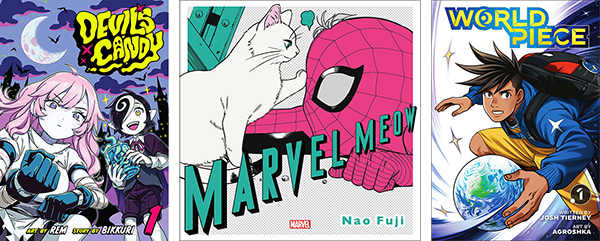
Viz Originals, an imprint launched by Viz in 2019 to publish original graphic novels by artists inspired by manga and anime, is off to a strong start with the manga adaptation of celebrated YA author Rainbow Rowell’s Fangirl, adapted by Sam Maggs and Gabi Nam, followed by two summer releases: World Piece, a sci-fi adventure series by Josh Tierney and Agroshka, and Devil’s Candy, a popular webcomic and supernatural high school comedy by REM and Bikkuri. Viz also recently announced a copublishing partnership with Marvel Comics to release English editions of Marvel stories created in Japan, starting in November with the release of Marvel Meow, featuring Captain Marvel’s “cat” Chewy, drawn by Nao Fuji.
TokyoPop is continuing its line of Disney-licensed manga releases as well as supporting a small but growing roster of original comics produced by a global stable of creators. Seven Seas Entertainment has partnered with HiveWorks, a graphic novel publisher and webcomic studio and platform, to release many of its popular webcomics in print editions—among them, the heartwarming LGBTQ fantasy Life of Melody by Mari Costa; Sleepless Domain by Mary Cagle, a magical girl drama; and Persephone: Hades’ Torment by Allison Shaw, a steamy Greek mythology–inspired romance.
Comics from South Korea have always been a part of the publishing mix at Yen Press, says editor-in-chief JuYoung Lee, who joined the U.S. house in 2007 after years working in the South Korean comics industry. “I can safely say that BTS had a huge impact,” Lee notes, “and Korean content itself is considered more ‘hip’ than ever before. We are getting a lot of interest from retailers on what’s coming from Korea. Webcomics have been a growing industry in Korea for a while now, and it has just exploded in recent years. This has allowed the webcomics platforms to go from seeking individual creators to establishing larger digital comics studios that can produce high quality content in a short period of time to keep up with the demand of readers who want to be able to quickly read the next story. The amount of content they can produce—and the quality—is really outstanding.”
Ten years ago, Lee explains, many American publishers tried to brand manhwa (or South Korean comics) as Japanese manga. “I was told that’s the way to go to sell Korean content,” she says. “Now people are actually looking for stories from Korea, which is a huge difference.”
Supply chain problems
Kevin Hamric, v-p, publishing sales at Viz Media (l.), Yae Sahashi, v-p of sales and marketing at Kodansha (r.).
Despite such impressive growth, selling more books can mean more problems. Manga publishers across the board report pandemic-related printing and shipping delays that have created shortages, just when demand for manga in print is on the rise.
“We just can’t get all the books we want to reprint right now, and the demand from the readers is higher than ever,” says Hamric.
Yen Press’s Hassler agrees: “Printer capacity issues were stretched last year, and the increase in sales this year has exacerbated the problem.”
Sentar laments, “This will likely be a problem for months to come, since demand isn’t going down! It’s a good problem to have, but we’re sorry for all the retailers and readers who have to wait longer than usual to access some print copies.”
Ed Chavez, publisher at the small indie manga house Denpa, says, “Even at the beginning of 2020, we were seeing about two to three weeks of additional lead time for first printings. Starting in fall 2020, we started seeing delays of four to six weeks from domestic printers.”
With limited capacity to print, publishers have had to make some adjustments and difficult decisions. “The first adjustment has been to try to get ahead of those titles that are so hot right now that we can’t keep up with demand, seemingly no matter how much we print,” Hassler says.
Meanwhile, at Viz Media, Hamric says, “We have to make decisions weekly as to what we can reprint and what will need to wait a while longer. We are in regular contact with our suppliers and looking at other possible solutions. The retailers are well aware of the situation, as it is an industry-wide issue and not confined to just our category. As of right now, I do not see how this will be resolved this year.”
Looking ahead
As the pandemic stretches on, many anime and comics conventions remain virtual only, or are in a “wait-and-see” mode as the number of vaccinated people rise and lockdown restrictions are eased. While the manga publishers we spoke with are optimistic overall, they remain wary of what kinds of changes to expect in a post-pandemic world.
Viz’s Hamric says he believes the upward sales trend will continue, though “it could be interrupted by how we start opening up the country, how people choose to spend their money, as well as how long the current printer issues continue.” He adds, “We hope that readers will continue with the new series they have started and we also hope that the new readers we have gained will start reading more series.”
Hassler says, “We don’t see any end in sight to strong sales in the category at the moment. I expect the rate of increase to taper, simply because you can’t maintain 100% growth exponentially, but I don’t see this as a short-lived spike.”
Kodansha’s Sahashi notes, “We feel very fortunate and excited to be publishing at a time when interest and enthusiasm for anime and manga is at an all-time high. And we have plenty of existing and upcoming series that we’re thrilled to share with fans looking for amazing manga content.”
According to Seven Seas’ Sentar, “Our hot titles are spread across many genres and formats, and demand for everything is up both for print and for digital formats. Although I’m sure we’ll see some peaks and valleys in demand this year as the world continues to adjust to Covid-19, I think a lot of this growth is here to stay. It’s been a wild year, but we have even more cooking, and we can’t wait to announce it.”
*******************************************************
Check out my new book!
And don't forget to subscribe.




 We love your work on Kill la Kill and